

Why Structural Naming Is the Foundation of Scalable CRM Operations
Monitoring Done Right #1

Executive Summary
As CRM programs expand across markets, brands, and teams, structural consistency becomes critical. Bloomreach Engagement provides strong system-generated metadata, but enterprise operations require more than behavioral tracking. They require consistent structure.
This article explains why structural naming conventions improve operational efficiency and reporting reliability and how automated structural monitoring ensures that this structure remains intact as complexity increases.
System Metadata Is Not the Same as Business Intent
Bloomreach automatically records campaign_name, action_name, action_type, status, and trigger information. This provides a solid behavioral baseline.
However, system metadata describes what happened. It does not encode why the campaign exists or how it should be evaluated strategically.
For example, IP-based location reflects where a user opens an email. It does not reflect the intended market of the campaign. A campaign built for the UK market but opened while the user is traveling elsewhere will be logged under the session country, not the strategic market.
To evaluate performance by strategy rather than session behavior, intent must be encoded explicitly through structural naming.
Structural Naming as Operational Infrastructure
As CRM environments grow, multiple stakeholders interact within the same Bloomreach project:
CRM and lifecycle teams
Marketing operations
Brand teams
Agencies
Local market owners
At scale, naming becomes infrastructure. It enables:
Clear delegation
Fast and predictable search
Programmatic filtering
Cross-project comparability
Cleaner onboarding for new team members
Case A: Multi-Project Governance
In large organizations, Bloomreach environments are often split into separate projects by brand or business unit. This improves access control and accountability.
However, leadership still needs consolidated visibility across all projects to evaluate:
Performance by team
Performance by market
Performance by campaign type
Without shared structural naming logic, cross-project evaluation requires manual normalization in BI tools.
With consistent structural placement and controlled dictionaries, reporting logic becomes reusable and comparable across brands.
Structural alignment enables decentralized execution with centralized evaluation.
Case B: Market Identification and Operational Friction
In another organization, market identifiers such as DE, AT, or CH were placed inconsistently within campaign names.
Operational friction followed:
Updating all DACH campaigns required manual filtering
Performance evaluation required custom segments built from campaign IDs
Delegation tasks took longer because filtering could not be automated
When a market occupies a fixed structural position, filtering becomes programmatic.
When it does not, filtering becomes manual.
Structural naming directly improves operational efficiency.
A Practical Structural Model
A scalable naming approach separates scenario-level organization from asset-level attribution.
Scenario structure typically follows:
[type]_[date]_[team]_[market]_[campaignName]
Where the market can be:
Region grouping such as ww, emea, dach
ISO-2 country codes such as gb, de, ch, at, us
At the asset level, additional segments extend the macrostructure:
[channel]_[objective]_[audience]_[version]
CampaignName may use camelCase or kebab-case. Underscores remain reserved for structural segmentation.
The exact dictionaries vary by organization. What matters is fixed positioning and controlled values.
The Immutability Constraint
Bloomreach stores events in a schema-less structure. Once recorded, event attributes cannot be rewritten retroactively.
If structural rules are violated, inconsistencies persist across all related events. Over time, teams compensate with mapping logic in BI systems and manual normalization.
Monitoring does not eliminate human variability.
It ensures deviations are detected early and corrected before they scale.
Structural Monitoring in Practice
Below is an example of a structural naming monitoring alert generated automatically within Bloomreach.
Instead of presenting the alert as a single block, it is useful to understand its components step by step.
1. Executive Summary Section
This is the header of the alert.
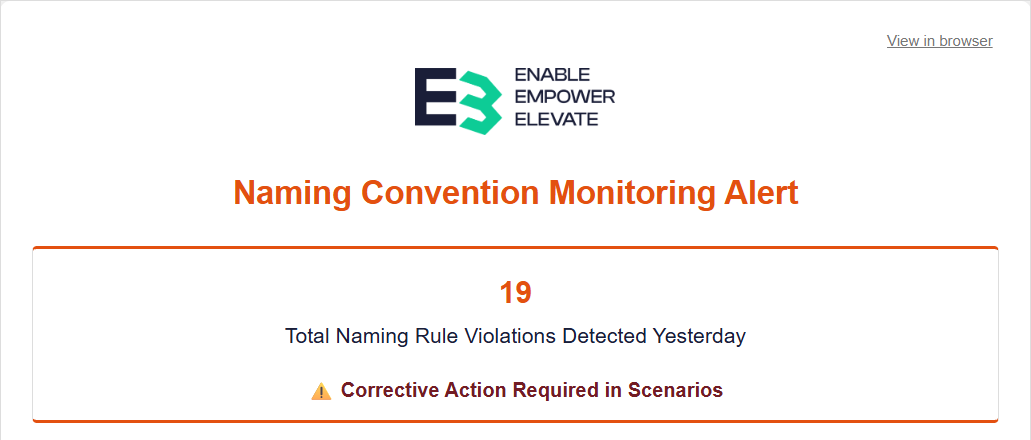
This section shows:
Total Naming Rule Violations Detected Yesterday
Clear indicator that corrective action is required
In this example, 19 violations were detected.
This immediately answers three operational questions:
Did anything break yesterday?
Is action required?
What is the scale of the issue?
If zero violations are detected, no alert is sent. This prevents alert fatigue.
2. Scenario-Level Violations
This section evaluates the structural integrity of the scenario itself.
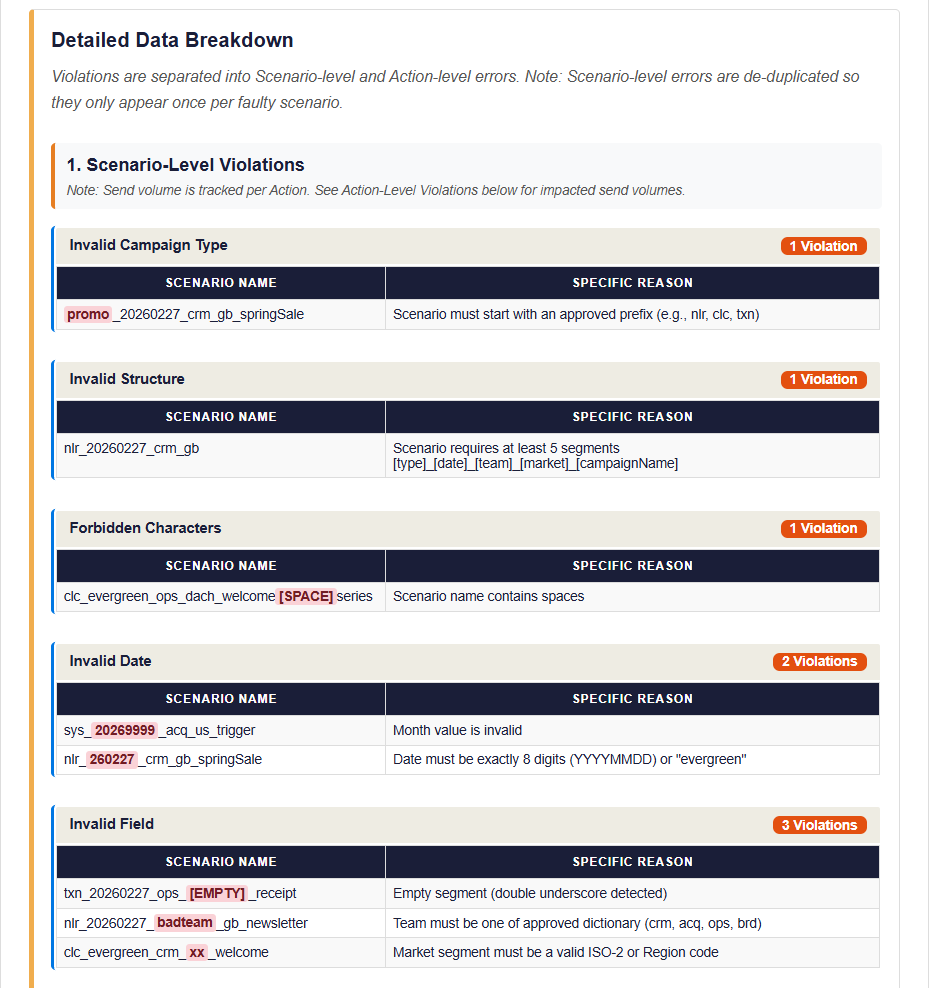
Violations are grouped by rule category, including:
Invalid Campaign Type
Invalid Structure
Forbidden Characters
Invalid Date
Invalid Field
Faulty segments are highlighted directly within the scenario name.
Examples of validation logic applied:
Scenario must start with approved type: nlr, clc, ads, sys, txn
Date must match YYYYMMDD or “evergreen”
Market must be valid ISO-2 code, such as gb, de, us or approved region, such as ww, emea, dach
No empty segments (double underscores)
No spaces inside structural fields
Scenario-level violations affect the macro organization of the campaign and therefore impact filtering and reporting consistency.
3. Action-Level Violations
This section validates the asset-level structure.
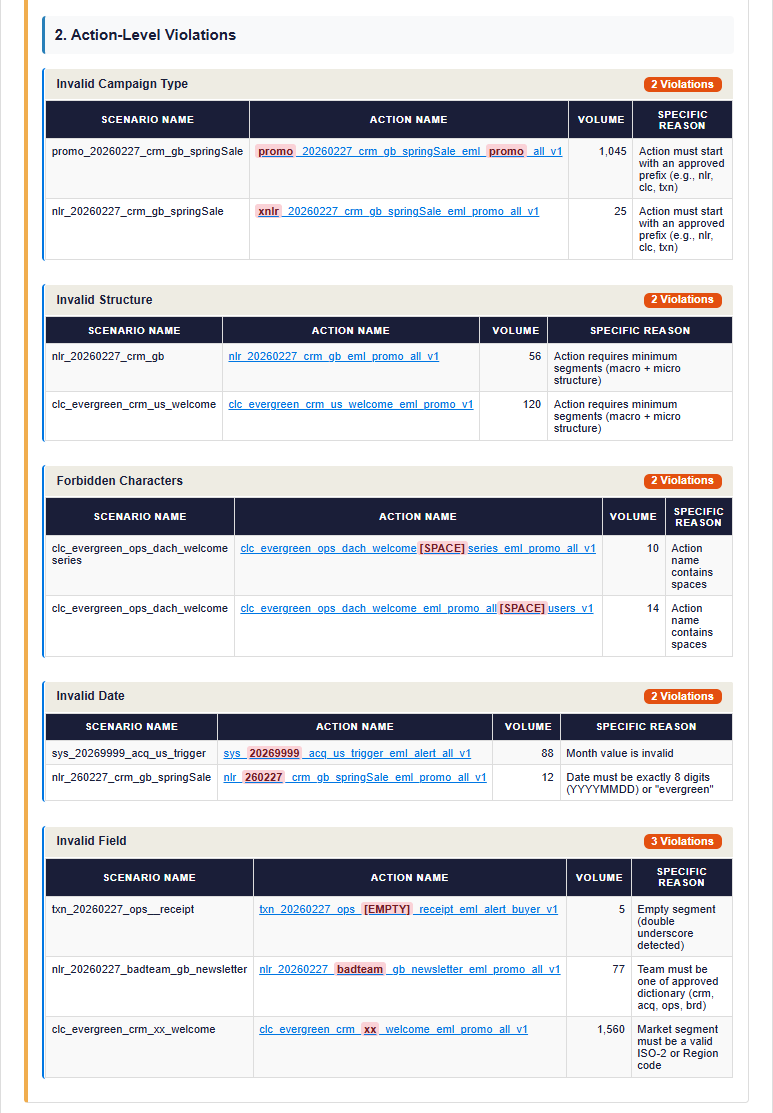
This layer checks that individual email, SMS, push, or webhook nodes follow the expected macro plus micro structure.
Examples of validation logic:
Action must extend the macro naming structure correctly
Channel must be valid such as eml, sms, psh, whk
Minimum segment count must be respected
Dictionary values must match approved lists
No forbidden characters
The alert also displays impacted volume per action. This allows prioritization. An error affecting 1,500 sends is operationally different from one affecting 5.
4. Audit Definitions and Rule Transparency
At the bottom of the alert, validation rules are summarized clearly.
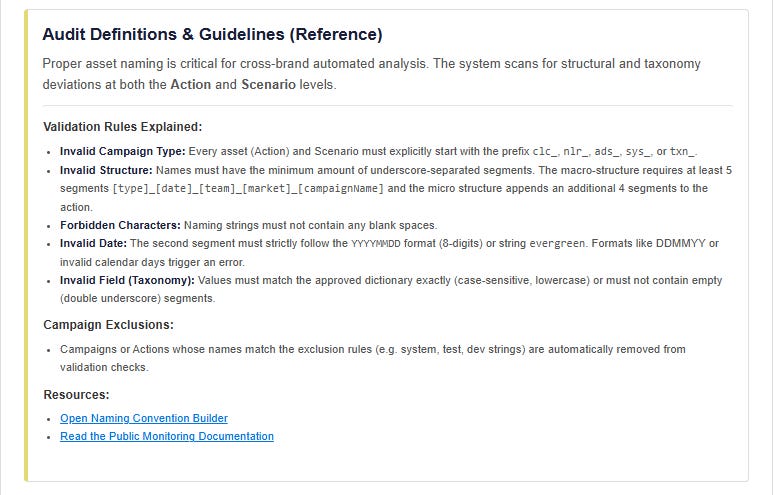
This section explains:
What each rule category means
How structural validation works
Which exclusions apply
The monitoring logic is transparent. Teams understand exactly which rules are enforced and why.
Monitoring should reinforce governance, not introduce hidden constraints.
5. Alert Recipients and Operational Ownership
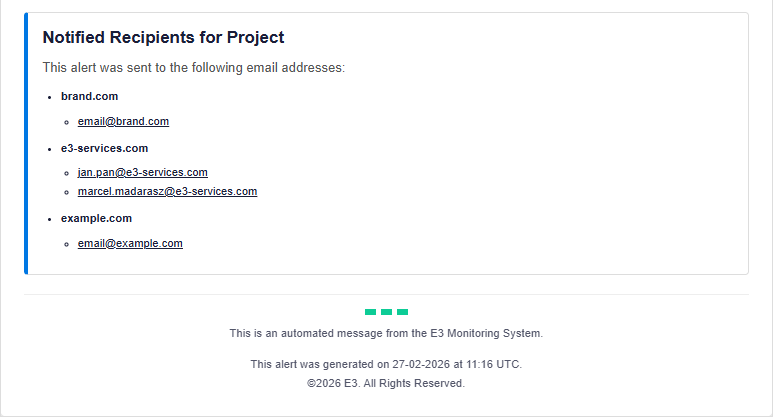
At the bottom of the alert, designated recipients are listed per project.
Recipients typically include:
CRM leads
Marketing operations
Technical owners
External agency stakeholders
This ensures:
Clear accountability
Shared visibility
No single point of failure
Transparent escalation paths
Structural monitoring is most effective when it is not dependent on one individual noticing inconsistencies.
By explicitly defining distribution, the system reinforces ownership as part of the monitoring architecture.
Why This Alert Structure Matters
The alert does not simply signal that something is wrong.
It provides:
Categorized violations
Specific reason descriptions
Highlighted faulty segments
Impacted volume
Transparent validation logic
This transforms structural governance into a controlled operational process rather than reactive cleanup.
Conclusion
Structural naming conventions enable:
Faster onboarding
Clear delegation
Programmatic filtering
Cross-project alignment
Clean historical archives
Monitoring ensures that once a structure is defined, it remains consistent as teams and programs grow.
In Part 2 of the Monitoring Done Right series, we will move from structural integrity to data integrity, focusing on how to monitor the foundational health of your Bloomreach project beyond naming conventions.